ORID Focused Conversation Method
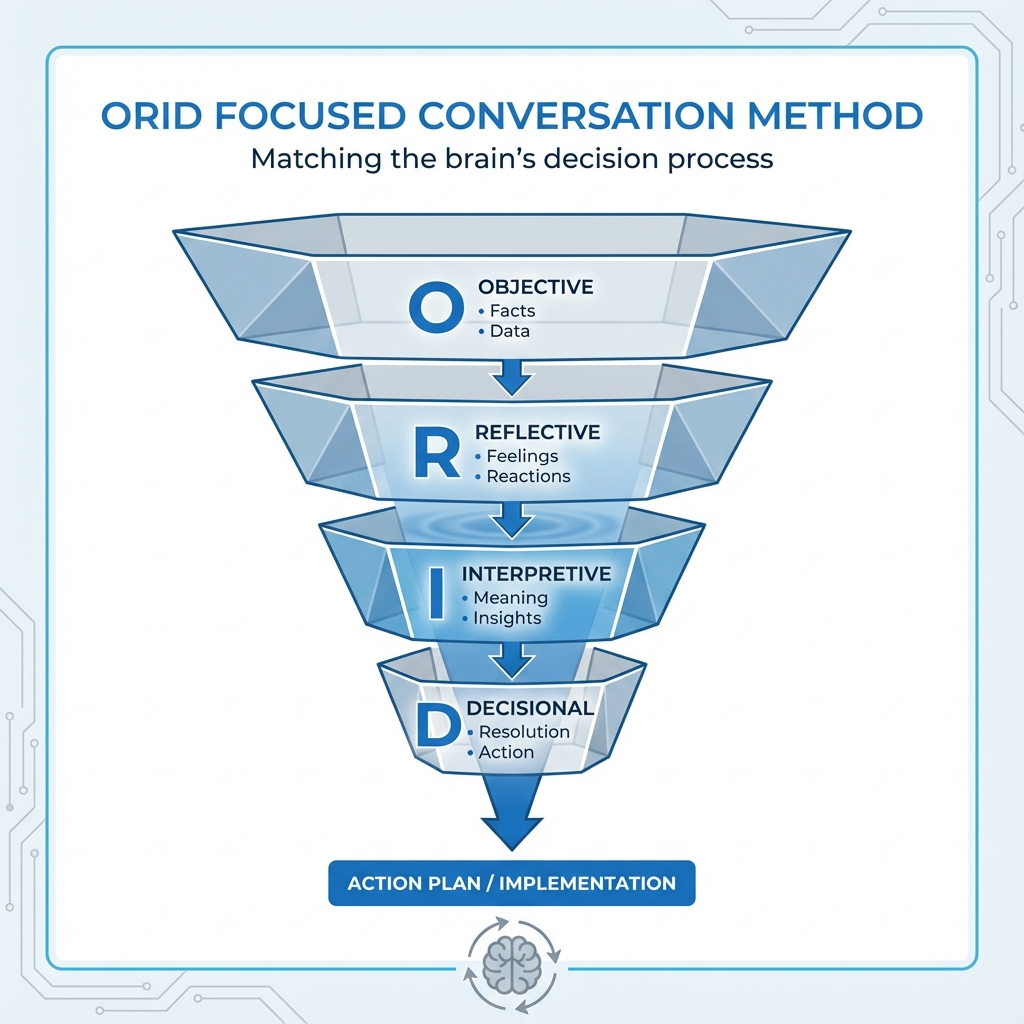
In team meetings or debriefing discussions, we often encounter the dilemma where discussions quickly devolve into arguments over solutions, or become a "one-man show" by a few individuals, while many remain silent, leading to meetings that neither reach consensus nor generate true deep thinking. The ORID Focused Conversation Method is a powerful and elegant structured facilitation technique designed to solve this problem. It systematically guides a discussion through four logically progressive levels, ensuring that the team moves from objective facts to subjective feelings, then to interpretive analysis, and finally to informed decisions.
ORID is an acronym for four levels, simulating the natural process of the human brain processing information and forming decisions:
- O - Objective: About facts and data.
- R - Reflective: About internal reactions and emotions.
- I - Interpretive: About meaning, value, and significance.
- D - Decisional: About future actions and resolutions.
By strictly following this "O-R-I-D" sequence in designing and guiding questions, the facilitator can ensure that every participant thinks on the same "channel," avoiding chaotic clashes of different thought levels. It creates a safe, in-depth discussion space, allowing the team's collective wisdom to truly emerge.
Key takeaways
- Four levels, always in order: Objective (facts) → Reflective (feelings) → Interpretive (meaning) → Decisional (action).
- Start with facts everyone can agree on; this gives every participant the same starting point.
- Don't skip Reflective: unspoken emotions resurface later as resistance to decisions.
- Prepare questions in advance for each level, but adapt them as the conversation unfolds.
- End with concrete decisions: owners, actions and deadlines, not just insights.
Detailed Explanation of the Four Levels of ORID
The four levels of ORID, like a funnel, guide the discussion from the concrete, objective external world, gradually deepening into the abstract, profound inner world, and finally returning to concrete future actions.
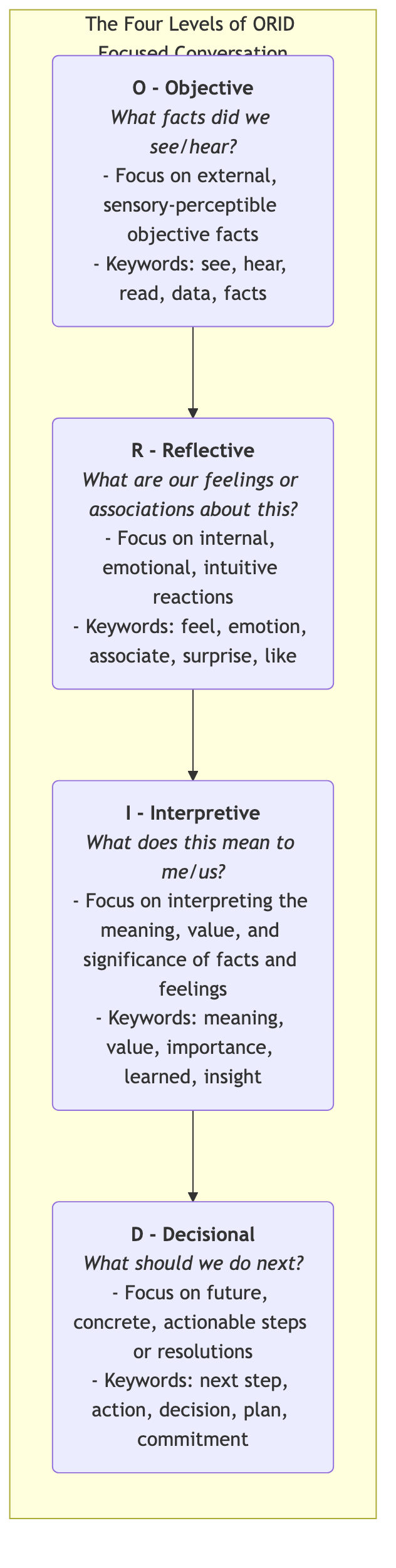
How to Design and Facilitate an ORID Discussion
Successfully applying ORID hinges on the facilitator's ability to design a series of precise, open-ended, and logical questions for each level.
-
Step One: Preparation Phase
- Clarify Discussion Focus: Clearly define the core topic of this ORID discussion. For example, "Debriefing our 'Dolphin' project from last quarter."
- Design ORID Questions: Prepare your list of guiding questions in advance for each of the four levels. Prepare at least 2-3 questions for each level.
-
Step Two: O - Objective Level: Establish a Common Factual Basis
- Purpose: To ensure all participants start from the same objective, undisputed factual point. This step aims to "clear the mind" and eliminate subjective assumptions.
- Guiding Question Examples:
- "When we look back at the 'Dolphin' project, what specific data or facts did you see?"
- "Please recall, during the project, what was the most memorable sentence or scene for you?"
- "If we look at the project timeline, what key event nodes occurred?"
-
Step Three: R - Reflective Level: Connect Personal Inner Experiences
- Purpose: To provide a safe space for the team's emotions and intuitive feelings to be expressed, based on facts. This step helps build team trust and psychological safety.
- Guiding Question Examples:
- "At what stage of the project did you feel most energized or excited?"
- "What moment made you feel most anxious, frustrated, or confused?"
- "What was your first reaction when you heard the final customer feedback?"
-
Step Four: I - Interpretive Level: Uncover Deeper Meaning and Insights
- Purpose: This is the "value sublimation" stage of the discussion. Guide the team to extract deeper meanings, patterns, and key learnings from facts and feelings.
- Guiding Question Examples:
- "What is the most important value and meaning of this project's success (or failure) for our team?"
- "What is the most valuable lesson we learned from this?"
- "How did this project change our understanding of 'customer needs'?"
-
Step Five: D - Decisional Level: Form Clear Future Actions
- Purpose: To translate all previous discussions into concrete, actionable future steps or resolutions, ensuring the meeting produces practical outcomes.
- Guiding Question Examples:
- "Based on our discussion today, what is the first and most important change we need to make to make our next project more successful?"
- "What should we start doing immediately? Stop doing? Continue doing?"
- "Regarding the next steps, who is responsible? What is the deadline?"
Application Cases
Case 1: Project Retrospective Meeting
- Focus: Debriefing a recently completed complex project with both successes and failures.
- ORID Application:
- O: "Let's first review the project data: How long was the final delivery delayed compared to the original plan? How much was the budget overspent? What was the user activity metric?"
- R: "During the week when the project was most severely delayed, what was the general feeling among everyone?"
- I: "What was the most important lesson we learned about 'cross-departmental communication' from this delay?"
- D: "To avoid similar problems in the future, we decided that in all cross-departmental projects, a clear RACI matrix must be established at the initiation stage. This will be handled by the Project Management Office and completed by the end of the next quarter."
Case 2: Team Learning Sharing Session After Reading a Book
- Focus: Team members share learnings after jointly reading "The Lean Startup."
- ORID Application:
- O: "What was the most impressive concept, story, or sentence in the book for you?"
- R: "When you read about the concept of 'MVP,' what failed product of our own did you associate it with? How did you feel at that time?"
- I: "What is the biggest inspiration and challenge of the book's core ideas for our current product development process?"
- D: "We decided to try a 'landing page MVP' experiment for the next new feature development. Product Manager Xiao Wang will be responsible for launching it within two weeks."
Case 3: Mediation Meeting After a Team Conflict
- Focus: Helping two colleagues who had a conflict due to work disagreements engage in an open, constructive dialogue.
- ORID Application:
- O: The facilitator guides both parties to objectively state, "What exactly happened in yesterday afternoon's meeting? What did you say? What did he say?" (State only facts, without judgment).
- R: "How did you feel internally when you heard the other person say that? (Did you feel wronged, misunderstood, angry?)"
- I: "What do you think are the truly important but unarticulated needs behind this conflict? What does this mean for your future working relationship?"
- D: "What behavioral change are you both willing to commit to jointly for more effective future collaboration?"
Advantages and Challenges of ORID
Core Advantages
- Enhances Meeting Depth and Quality: Through structured facilitation, ensures discussions delve deeper, reaching the core issues.
- Ensures Full Participation: The design of the four levels, especially O and R, provides safe and easy opportunities for less vocal or introverted members to speak.
- Builds Team Consensus: Starting from a common factual basis and gradually moving towards a shared decision greatly promotes team consensus building.
- Highly Versatile: Can be applied to almost any scenario requiring in-depth dialogue, such as project retrospectives, strategic discussions, team building, and training sharing.
Potential Challenges
- High Demands on Facilitator: The success of ORID heavily relies on the facilitator's proficiency in the process and careful design of questioning techniques. A good facilitator is the soul of an ORID discussion.
- Time-Consuming: An in-depth ORID discussion requires ample time and is not suitable for situations requiring quick, urgent decisions.
- Requires Participant Commitment: Requires all participants to be willing to follow the structure and engage in open, honest sharing.
ORID Question Bank
| Level | Purpose | Sample questions |
|---|---|---|
| O – Objective | Establish shared facts | What happened? What did you see or hear? Which numbers stand out? What words or moments do you remember? |
| R – Reflective | Surface emotional reactions | What surprised you? What frustrated or pleased you? When did you feel most engaged, or most worried? |
| I – Interpretive | Make sense of it together | What does this mean for us? Why do you think it happened? What have we learned? What patterns do you see? |
| D – Decisional | Commit to action | What will we do differently? What's our first step? Who will own it, and by when? |
ORID Retrospective Template (60 minutes)
| Time | Level | Activity |
|---|---|---|
| 0–5 min | Opening | State the purpose and the ground rules (one person speaks at a time; no judging others' feelings) |
| 5–15 min | Objective | Build a timeline of the project on the wall: milestones, metrics, key events |
| 15–25 min | Reflective | Each person marks highs and lows on the timeline and shares one feeling |
| 25–45 min | Interpretive | Cluster observations; discuss causes and lessons for the 2–3 biggest themes |
| 45–58 min | Decisional | Agree on up to three actions, each with an owner and a deadline |
| 58–60 min | Closing | Each person says one word about how they feel leaving the meeting |
Facilitation Tips
- Ask open questions, not yes/no ones: "What did you notice?" rather than "Did you notice the delay?"
- Go round the room at the Objective level so quieter participants speak early, which makes them more likely to contribute later.
- Gently redirect level-jumping: when someone offers a solution during the Objective stage, note it for later ("let's hold that for the decisions part").
- Accept all feelings at the Reflective level without debating them.
- Summarize between levels so the group sees how facts lead to meaning and then to action.
Common Mistakes
- Jumping straight to decisions. Without shared facts and meaning, decisions are made on assumptions and are rarely owned by the group.
- Skipping the Reflective level because it feels "soft". Emotions that aren't voiced often come back as objections later.
- Leading questions. "Don't you think the plan was too ambitious?" signals the answer you want and shuts down honest input.
- Too many questions per level. Two or three good questions are better than ten rushed ones.
- No follow-through. Decisions without owners and dates turn the conversation into a pleasant chat with no effect.
ORID vs. Other Structured Conversation Tools
| ORID | Six Thinking Hats | SBI Feedback | |
|---|---|---|---|
| Purpose | Reflect and reach shared decisions | Explore a topic from all angles | Give feedback to one person |
| Structure | Facts → Feelings → Meaning → Decisions | Six modes of thinking in a chosen order | Situation → Behavior → Impact |
| Best for | Retrospectives, debriefs, learning sessions | Evaluating proposals, generating ideas | One-to-one feedback |
Frequently Asked Questions
What does ORID stand for?
Objective, Reflective, Interpretive and Decisional, the four levels of the Focused Conversation Method developed by the Institute of Cultural Affairs (ICA).
Can I use ORID on my own?
Yes, for journaling or personal reflection: write down what happened, how you felt, what it means and what you'll do next. It is a simple structure for learning from experience.
How long does an ORID conversation take?
Anything from 15 minutes for a quick debrief to two hours for a major retrospective. Keep the four levels in proportion: the Interpretive and Decisional levels usually need the most time.
What if the group gets stuck at one level?
Summarize what has been said and ask a question from the next level to move on. If disagreement persists at the Interpretive level, record the different views and decide which actions make sense either way.
Extensions and Connections
- Action Research: ORID is an extremely effective practical tool for the "Reflect" stage in action research.
- Appreciative Inquiry: ORID can be combined with the principles of Appreciative Inquiry by designing positive ORID questions focused on strengths and successful experiences to guide a positive, empowering discussion.
Reference: The ORID Focused Conversation Method was developed by the Institute of Cultural Affairs (ICA Canada) in the 1970s and is one of the core tools in their "Technology of Participation (ToP)" series of facilitation methods. Laura Spencer's "Winning Through Participation" and R. Brian Stanfield's "The Art of Focused Conversation" are authoritative references for this method.