Pomodoro Technique
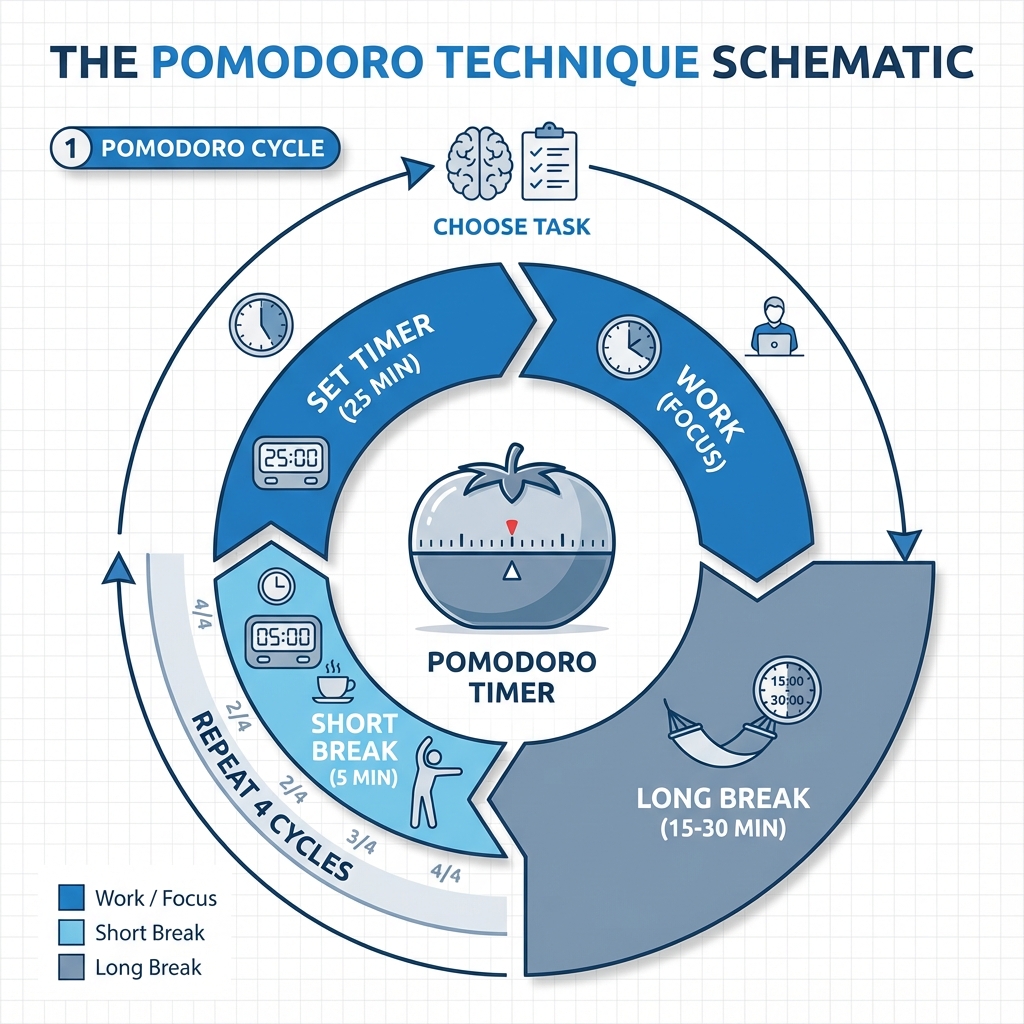
We've all been there: facing a daunting and complex task, procrastinating on starting; or while working, our minds wander, easily interrupted by every phone vibration or casual chat from a colleague. As a result, we end the day exhausted, yet our efficiency is far from satisfactory. The Pomodoro Technique is an incredibly simple yet exceptionally effective time management method designed to solve this common dilemma.
It doesn't require complex tools or profound theories. Its core lies in using a timer to divide work time into several 25-minute, highly focused "Pomodoros," interspersed with short breaks. This rhythmic cycle of "focus-break" aims to help us overcome procrastination, resist distractions, and maintain a highly efficient work state in a sustainable way.
Key takeaways
- The basic cycle: 25 minutes of focused work, a 5-minute break; after four pomodoros, a longer 15–30 minute break.
- A pomodoro is indivisible: if you're interrupted and must switch tasks, that pomodoro is void; start a new one.
- Protect it with "inform, negotiate, call back": defer interruptions instead of reacting to them.
- Track and estimate: counting pomodoros per task makes your time estimates much more accurate.
- Adjust the length: 25/5 is a starting point; deep work often suits 50/10 or 90-minute blocks.
The Core Cycle of the Pomodoro Technique
"Pomodoro" means "tomato" in Italian, a name derived from the tomato-shaped kitchen timer used by the method's founder, Francesco Cirillo, during his university days. Its workflow is elegant and concise, forming a complete closed loop.
The core philosophy of this cycle is:
- Lowering the Barrier to Entry: Compared to the grand goal of "I'm going to work all day," the commitment to "I'll focus for 25 minutes first" is clearly easier to get started with.
- Protecting Focus: Within a "Pomodoro," focus is sacred and inviolable. Any interruption means the failure of that Pomodoro, requiring a restart. This forces us to learn to say "no" to distractions.
- Making Breaks Essential: Unlike many people's habit of working straight through, the Pomodoro Technique emphasizes the value of breaks. Short breaks are not a waste of time; they are for recharging for the next focused period, keeping the brain sharp and efficient.
Pomodoro Technique Flowchart
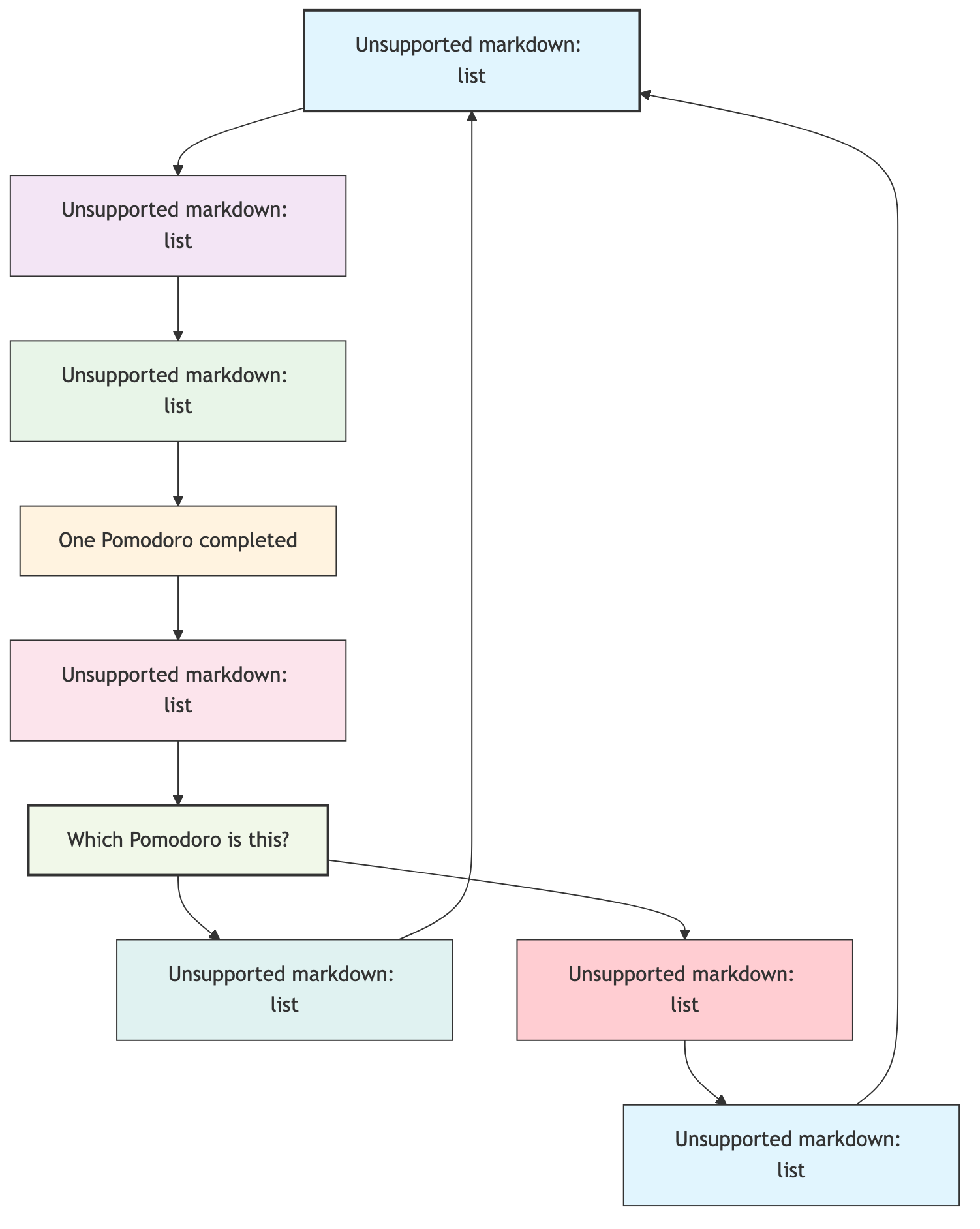
Practicing the Pomodoro Technique: Step-by-Step Guide
Integrating the Pomodoro Technique into your daily routine only requires following these simple steps:
-
Plan and Select Before starting your day or a work unit, review your to-do list. Based on priority, select the tasks you will dedicate "Pomodoros" to today.
-
Start the First Pomodoro Choose the first task on your list, set your timer (phone app, computer software, or a real kitchen timer) for 25 minutes, and immediately immerse yourself in the work.
-
The Sacred 25 Minutes During these 25 minutes, only the current task exists in your world. This is deliberate training for your focus.
- How to handle internal distractions? When an unrelated thought suddenly pops into your head (e.g., "Oh, I need to remember to buy milk"), don't follow it. Quickly jot down the thought on a piece of paper nearby, then immediately pull your attention back to the task.
- How to handle external distractions? If a colleague comes over to chat, you can politely tell them: "I'm in a focused session, can I find you in 5 minutes?" If it's a phone call, you can hang up or put it on silent. The key is to defend the integrity of this Pomodoro. If a distraction is urgent and unavoidable, that Pomodoro is void; after handling the urgent matter, you need to start a new Pomodoro from scratch.
-
Mandatory Short Break When the timer rings, no matter where you are in your task, you must stop immediately. Mark the just-completed Pomodoro on your task list (e.g., with an "X"). Then, take a 5-minute short break. This break is mandatory; you should stand up, stretch, drink some water, or look out the window. The key is to let your brain disengage from the highly focused state it was just in.
-
Cycle and Long Break After the short break, immediately start the next Pomodoro. After every four Pomodoros, take a longer break, about 15 to 30 minutes. You can use this time to take a walk, reply to non-urgent messages, or do something completely relaxing. This long break is crucial for restoring energy and consolidating memory.
Application Scenarios of the Pomodoro Technique
Scenario 1: Software Developer Tackling a Complex Feature
A developer needs to write a complex data synchronization module for a new application. This task seems daunting. He can use the Pomodoro Technique to break it down:
- Pomodoro 1-2: Research technical documentation, design the module's architecture. (After a 20-minute long break)
- Pomodoro 3: Write the core data transfer code.
- Pomodoro 4: Write the data validation code.
- In this way, he transforms a vague, large task into a series of clear, executable focused sessions.
Scenario 2: Student Preparing for Final Exams
A student needs to review an entire textbook on Macroeconomics. Starting directly might feel overwhelming due to the sheer volume of content.
- Pomodoro 1: Quickly skim the first chapter to understand its outline.
- Pomodoro 2: Read and understand the first section of the first chapter in depth, and take notes.
- Pomodoro 3: Complete the exercises for the first section.
- This method helps the student maintain continuous learning motivation and ensures a balance between study and rest, avoiding long periods of ineffective reading.
Scenario 3: Designer Completing a Poster Design
A designer needs to complete an event poster in one afternoon. The design process is full of uncertainties.
- Pomodoro 1: Gather inspiration and materials.
- Pomodoro 2: Brainstorm and sketch 3 different layout drafts.
- Pomodoro 3: Select one draft, refine and color it.
- Pomodoro 4: Adjust details and text layout.
- Breaks between Pomodoros help the designer step back from the details and view their work with a fresh perspective.
Advantages and Applicability of the Pomodoro Technique
Core Advantages
- Overcome Procrastination: Minimizes the psychological burden of starting work.
- Improve Focus: Deliberately trains the ability to resist distractions within a fixed time.
- Quantify Effort: By recording the number of Pomodoros, you can clearly see your investment in each task.
- Reduce Anxiety: Breaks down large tasks into smaller chunks, giving a greater sense of control.
Applicability and Limitations
- Ideal Scenarios: Very suitable for independent tasks that can be clearly broken down and require high concentration, such as writing, coding, reviewing, processing reports, etc.
- Challenging Scenarios: For creative work that requires long periods of uninterrupted thinking (which might interrupt "flow"), or roles that require frequent collaboration and constant responsiveness, a strict 25-minute cycle might not be suitable. In these cases, the duration of the Pomodoro can be flexibly adjusted (e.g., 50 minutes of focus, 10 minutes of rest).
Handling Interruptions
Interruptions are the main enemy of a pomodoro. Francesco Cirillo, the technique's creator, distinguishes two kinds:
| Type | Example | What to do |
|---|---|---|
| Internal (from yourself) | "I should check that email", "let me look this up" | Write it on an "unplanned" list and return to the task; deal with it in the break or a later pomodoro |
| External (from others) | A colleague's question, a chat message, a call | Inform ("I'm in the middle of something"), negotiate ("can I get back to you in 20 minutes?"), call back as promised |
If you truly must stop (an emergency), abandon the pomodoro and start a fresh one later rather than "pausing" it. The point is to protect uninterrupted blocks of attention.
Variations: Choosing an Interval Length
| Rhythm | Best for | Notes |
|---|---|---|
| 25 / 5 (classic) | Starting out, tasks you procrastinate on, admin work | Easy to begin; may be too short for deep creative work |
| 50 / 10 | Writing, coding, design | Enough time to get into flow while still forcing regular breaks |
| 90 / 20 | Deep work, research | Matches longer focus cycles; needs a protected calendar block |
| 15 / 3 | Very low energy, restarting after a long break | Lowers the barrier to starting at all |
Try one rhythm for a week before judging it, and use the same one for comparable tasks so your tracking stays meaningful.
Daily Pomodoro Tracking Template
| Task | Estimated pomodoros | Actual pomodoros | Internal interruptions | External interruptions | Notes |
|---|---|---|---|---|---|
| Draft quarterly report | 4 | ✗✗✗✗✗ (5) | ' ' | − | Data gathering took longer than expected |
| Reply to client emails | 1 | ✗ (1) | − | ||
| Review pull requests | 2 | ✗✗ (2) | ' | ||
| Unplanned & urgent | Call vendor about invoice |
Use ' for each internal interruption and − for each external one. After a week, compare estimates with actuals: the gap shows where your planning is systematically optimistic.
Common Mistakes
- Working through breaks. Skipping breaks feels productive but drains focus by mid-afternoon. The break is part of the method, so step away from the screen.
- Using breaks for social media or email. These pull you into new tasks and the break becomes another interruption. Stretch, walk, get water, look out of the window.
- Letting a timer run while multitasking. A pomodoro only counts if you worked on one task without switching. Background chat windows defeat the purpose.
- Applying it rigidly to everything. Meetings, collaborative work and tasks that need long uninterrupted flow don't always fit. Use it where it helps.
- Treating the count as a score. The goal isn't to "earn" as many pomodoros as possible but to understand and protect your attention. Quality of output still matters.
- Never adjusting the interval. If you constantly break flow at minute 25, try 50/10. If you can't make it to 25, try 15.
Pomodoro Technique vs. Time Blocking vs. GTD
| Pomodoro Technique | Time Blocking | GTD | |
|---|---|---|---|
| Main question | How do I stay focused right now? | When during the day will I do each thing? | What do I need to do, and what's next? |
| Unit | 25-minute intervals | Calendar blocks of 30 min–several hours | Tasks, projects, contexts |
| Strength | Starting, focus, rhythm of rest | Protects time for priorities | A trusted system that clears your head |
| Works well with | Time blocking, GTD | Pomodoros inside each block | Pomodoros to execute next actions |
Frequently Asked Questions
Why 25 minutes?
It's the length Francesco Cirillo found worked for him as a student, timed with a tomato-shaped kitchen timer ("pomodoro" is Italian for tomato). It's short enough to start easily and long enough to make progress. Adjust it to your work.
What should I do during the 5-minute break?
Anything that rests your attention: stand up, stretch, drink water, look into the distance. Avoid email, messages and social media, which start new mental threads.
What if I finish a task before the pomodoro ends?
Use the remaining minutes to review or improve what you just did ("overlearning"), or plan the next step. Don't start a different task mid-pomodoro.
Does the Pomodoro Technique help with procrastination?
Yes. Committing to just 25 minutes lowers the barrier to starting, and starting is usually the hardest part. Many people find they keep going once the first pomodoro is done.
Can teams use the Pomodoro Technique?
Yes. Some teams synchronize pomodoros for pair programming or co-working sessions, sharing breaks. It works best when everyone agrees not to interrupt each other during a pomodoro.
Extensions and Connections
The Pomodoro Technique can be perfectly combined with other time management and efficiency methods:
- GTD (Getting Things Done): GTD helps you clear your mind and organize your task list; the Pomodoro Technique is an excellent tactic for executing specific tasks on that list.
- Eisenhower Matrix: When deciding which tasks to complete today, you can use this matrix to help you prioritize and decide which tasks are worth investing valuable Pomodoros in.
Reference: Francesco Cirillo's official book "The Pomodoro Technique" is the best resource for understanding the complete philosophy and practical details behind this method.