Logic Tree Analysis
Faced with questions like "why did profit fall?" or "how do we double our users?", most people instinctively throw out a few causes or ideas from experience. The trouble is that experience points to familiar directions, and the real cause or the best idea may sit in a blind spot. A logic tree is a visual analysis tool that systematically breaks a complex problem or question into smaller, more manageable parts, until each part can be verified with data or acted on directly.
Its core principle is MECE (Mutually Exclusive, Collectively Exhaustive): the parts don't overlap, and together they leave nothing out. Logic trees are a signature tool of consulting firms such as McKinsey, and among the most practical structured-thinking tools for product managers, operators and managers.
Key takeaways
- Three common trees: the problem tree (why), the how tree (how), and the hypothesis tree (is it true?).
- MECE: branches at each level don't overlap and don't leave gaps. The easiest way to achieve it is to decompose with a formula or a process.
- How deep to go: until every leaf can be verified with data or assigned to someone to do.
- After building it: prune a problem tree with data and prioritize a how tree; don't try to work on every branch at once.
- A natural partner: once the analysis is done, use the Pyramid Principle to communicate the conclusion.
What Is the MECE Principle?
MECE is the heart of a logic tree and also where most mistakes happen.
- Mutually Exclusive: Branches at the same level don't overlap. Any specific cause belongs under exactly one branch.
- Collectively Exhaustive: Together, the branches at one level cover every possibility of the level above.
Take "analyzing a company's employees" as an example:
| How it is split | MECE? | Why |
|---|---|---|
| By age: under 30 / 30–45 / over 45 | ✓ | Everyone falls into exactly one group, and no one is left out |
| By role: managers / engineers / sales | ✗ | An engineering manager belongs to two groups (not exclusive); admin and finance are missing (not exhaustive) |
| By tenure: under 1 year / 1–3 years / over 3 years | ✓ | No overlaps, no gaps |
| By status: top performers / employees who need improvement | ✗ | The large group of "solid performers" in the middle is missing |
A practical trick: if you're unsure, add an "other" branch to guarantee exhaustiveness, then check how much ends up in it. If "other" is large, the dimension you chose isn't a good one.
Three Types of Logic Trees
Problem Tree (Diagnostic Tree)
- Purpose: To diagnose why a problem occurs.
- Structure: Starting from a core problem (the root), break it down repeatedly to find potential causes. Each level answers the level above in more depth.
- Use cases: Root cause analysis, diagnosing performance declines, troubleshooting.
How Tree (Solution Tree)
- Purpose: To generate and plan how to achieve a goal or solve a problem.
- Structure: Starting from an overall goal (the root), break it down into specific, executable strategies or actions.
- Use cases: Strategic planning, goal setting, project planning, finding solutions.
Hypothesis Tree
- Purpose: When information is limited and time is short, start with the most likely answer and break it into sub-hypotheses that must be verified.
- Structure: The root is a hypothesis (e.g. "profit fell mainly because raw materials got more expensive"); beneath it are the conditions that must be true for the hypothesis to hold.
- Use cases: Early stages of consulting projects, quick decisions, situations where you need a conclusion with minimal data. Its strength is that you only collect data that can prove or disprove the hypothesis; the risk is that if the initial hypothesis is far off, you must be willing to throw it out and start again.
Five Ways to Decompose a Problem
Not knowing which dimension to split on is the most common sticking point. These five methods cover most situations:
| Method | Idea | Example |
|---|---|---|
| Formula | Split using a mathematical relationship; MECE by construction | Profit = revenue − cost; revenue = traffic × conversion × average order value |
| Process | Split along the sequence of steps | Conversion = impression → click → sign-up → activation → payment |
| Segment | Split by the people or objects involved | Users = new + returning; channels = online + offline |
| Binary | Split into "A" and "not A" | Internal / external causes; controllable / uncontrollable factors |
| Existing framework | Use an established framework as the first level | 4P for marketing problems; Porter's Five Forces for industries; PESTEL for the macro environment |
Prefer formulas. A formula is MECE by definition, and every branch maps directly to data, which makes it the hardest method to get wrong.
How to Build a Logic Tree
Step One: Define the Core Problem or Goal
- Problem tree: State the problem clearly, e.g. "Why is our website's user churn rate rising?"
- How tree: Define the goal clearly, e.g. "How can we increase monthly active users by 20%?"
- Make this the root of the tree. Be specific: "business is bad" is a poor root; "East region sales fell 15% year over year in Q3" is a good one.
Step Two: Decompose the First Level (Apply MECE)
- Choose a dimension: Use one of the five methods above, trying a formula first.
- Check MECE: Make sure first-level branches don't overlap and don't leave anything important out.
- Problem tree example: Rising churn can be split into "new-user churn" and "existing-user churn".
- How tree example: Growing MAU can be split into "acquire new users", "increase engagement of existing users" and "win back lapsed users".
Step Three: Decompose Layer by Layer
- Keep asking: For each branch ask "why?" (problem tree) or "how, specifically?" (how tree).
- Each level may use a different dimension: split by formula at level one and by segment or process at level two, but use only one dimension within a level.
- Stop at actionability: Keep going until every leaf can be checked with data or handed to someone to execute. Three or four levels are usually enough.
Step Four: Verify and Prioritize
- Prune with data: For a problem tree, collect data to see which branches are real causes, and cut those the data rules out.
- Evaluate options: For a how tree, assess each action's feasibility, cost and expected impact.
- Find the critical path: Identify the causes or actions with the biggest effect and set priorities.
Practical Examples
Example 1: Problem Tree – "Why Is the Restaurant's Profit Falling?"
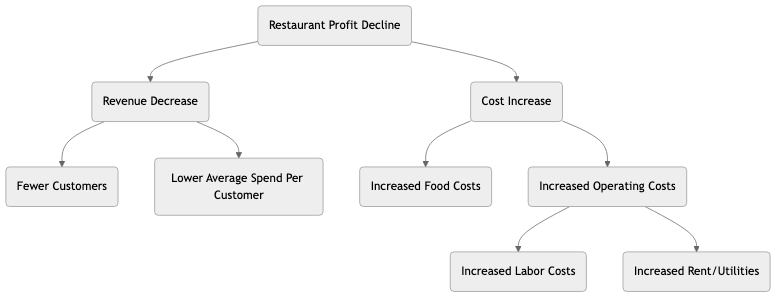
Using a formula for the first level means every branch maps to concrete data:
- Profit is falling
- Revenue is down
- Fewer customers: fewer new customers (less exposure on review sites? a new competitor nearby?); fewer regulars (changes in taste? worse service?)
- Lower average spend: fewer dishes per order (menu structure?); fewer premium dishes sold (signature dish quality slipping?)
- Costs are up
- Food costs: higher purchase prices; more waste (over-ordering? poor storage?)
- Labor costs
- Rent and other fixed costs
- Revenue is down
Analysis: Last month's data shows customer numbers roughly flat and costs barely changed, but average spend down 18%, driven by falling sales of the signature dishes. The manager focuses on that branch and prunes the rest. Digging in reveals that the signature dishes changed after a new chef joined, and the share of reviews saying "not as good as before" rose sharply.
Example 2: How Tree – "How Can I Improve My Personal Productivity?"

- Improve personal productivity
- Do the right things (choosing): list tasks before starting each day and sort them with the Eisenhower Matrix; review goals weekly and drop what no longer matters.
- Do things faster (executing): stay focused with the Pomodoro Technique; turn repetitive work into templates or automation.
- Waste less (interruptions): turn off unnecessary notifications; block a fixed daily focus period; batch email and messages instead of replying instantly.
Analysis: Splitting into "choosing – executing – interruptions" covers the main sources of productivity loss. You don't need to do everything at once; start with one or two low-effort, high-impact actions such as turning off notifications.
Example 3: How Tree – "How Do We Grow App MAU by 20%?"
- MAU = new active users + retained users + reactivated users
- Acquire more users: new acquisition channels, better app-store pages, referral rewards
- Improve retention: better onboarding, more reasons to come back each week (fresh content, reminders)
- Win back lapsed users: segment by reason for leaving, targeted comeback offers
Analysis: After decomposing with the formula, the team checks the data: new users are growing, but month-one retention is only 25%, so most new users leave immediately. Resources go to the "improve retention – onboarding" branch instead of more acquisition spending.
Logic Tree Template
| Level | Content | Dimension used | MECE? | How to verify / owner |
|---|---|---|---|---|
| Root | A specific, measurable problem or goal | — | — | — |
| Level 1 | Branch A / Branch B / Branch C | Formula / process / segment / binary / framework | ✓ / ✗ | |
| Level 2 | A1 / A2 … | |||
| Level 3 | Leaves that can be verified or executed directly | Data needed / person responsible |
Checklist
- The root is a specific, measurable problem, not a vague feeling
- Each level uses only one dimension
- Every level has been checked for overlaps and gaps
- Every leaf can be verified with data or executed directly
- Unimportant branches have been pruned based on data or priority
Common Mistakes
- Mixing dimensions within a level. Putting "revenue down", "fewer new customers" and "worse service" side by side mixes formula, segment and cause, which guarantees overlap.
- MECE for its own sake. A neatly split tree that has little to do with the decision is useless. The dimension should point to data or to action.
- Going too deep. Six or seven levels make the tree unwieldy. Three or four are usually enough; expand only the important branches.
- Building without verifying. Every branch of a problem tree is only a possibility. Trying to fix all branches without pruning spreads resources too thin.
- Leaves that can't be acted on. "Improve team motivation" can't be executed; keep breaking it down into concrete actions.
- Treating it like a mind map. Mind maps allow free association and overlap; logic trees demand strict hierarchy and MECE. They serve different purposes.
Logic Tree vs. Fishbone Diagram vs. Mind Map
| Logic Tree | Fishbone Diagram | Mind Map | |
|---|---|---|---|
| Main purpose | Break down a problem or goal | List the possible causes of a problem | Free association, organizing ideas |
| Structural rules | Strict hierarchy, MECE at each level | Causes grouped into categories | Free; overlaps allowed |
| Direction | Causes or solutions | Causes only | Any |
| Typical use | Analysis reports, planning, consulting | Quality problems, failure analysis | Brainstorming, reading notes, knowledge maps |
Frequently Asked Questions
What is the relationship between a logic tree and MECE?
MECE is the rule a logic tree must follow: branches at each level are mutually exclusive and collectively exhaustive. The logic tree is the tool; MECE is the test of whether you've used it correctly.
How many levels should a logic tree have?
There's no fixed rule; usually three or four. Stop when each leaf can be verified with data or acted on directly. Going further only adds complexity.
What tools can I use to draw a logic tree?
A whiteboard or paper is the most flexible. Digitally, mind-mapping tools such as XMind, Miro or draw.io work well, or simply a nested list in a document, which is how the examples on this page are written.
How is a logic tree different from the Pyramid Principle?
They look similar but run in opposite directions. A logic tree is for analysis: start from the problem and break it down to find causes or solutions. The Pyramid Principle is for communication: put the conclusion on top and support it with arguments below, so others accept it more easily.
How do I know whether my breakdown is MECE?
Ask two questions. Can any specific case belong to only one branch (exclusive)? Does every case have a branch to go to (exhaustive)? If you need a large "other" branch to make it exhaustive, choose a different dimension.
Extensions and Connections
- Pyramid Principle: A logic tree helps you think the problem through; the Pyramid Principle helps you present the conclusion.
- 5 Whys: Any branch of a problem tree can be drilled down vertically with the 5 Whys to reach a root cause.
- Fishbone Diagram: Also used to find causes, grouping them by category; well suited to team discussions.
- Problem Solving: The logic tree is the core tool for the "break the problem down" step of structured problem solving.
- Mind Mapping: A common workflow is to diverge freely with a mind map first, then tidy the result into a MECE logic tree.
Reference: The logic tree and the MECE principle were systematized and popularized at McKinsey & Company; Barbara Minto gave the classic account of MECE in The Pyramid Principle. Today they are standard analytical methods in management consulting, product management and operations.