Lean Canvas
In the early stages of a startup, the biggest risk is often not "can we build the product?" but "will anyone actually want the product we build?" Traditional business plans and business model canvases are excellent tools for mature companies, but for startups operating in high uncertainty, they can be overly complex and not sufficiently focused on the most critical risks. Lean Canvas was created to solve this problem; it is a brilliant adaptation of the Business Model Canvas, tailored specifically for early-stage entrepreneurs.
Lean Canvas, proposed by Ash Maurya in his book Running Lean, inherits the simplicity and intuitiveness of the Business Model Canvas but shifts the focus from a "complete description of the business model" to "systematically identifying and validating the highest-risk startup hypotheses." It centers around Problem-Solution and adds attention to key metrics and competitive advantages, more deeply embodying the "build-measure-learn" cycle of Lean Startup. It is a risk-oriented battle map guiding entrepreneurs through the fog.
Key takeaways
- One page, nine boxes, built around the problem and the customer rather than a finished business model.
- Fill it in fast (about 20 minutes) as Plan A, then treat every box as a hypothesis.
- Rank risks: customer and problem risk first, then product risk, then market risk.
- Validate by talking to customers with problem interviews before building, then solution interviews.
- Update the canvas after every experiment; it is a living record of what you've learned.
The Nine Blocks of Lean Canvas
Lean Canvas retains the nine blocks of the Business Model Canvas but replaces four of them to make it more actionable and risk-oriented.
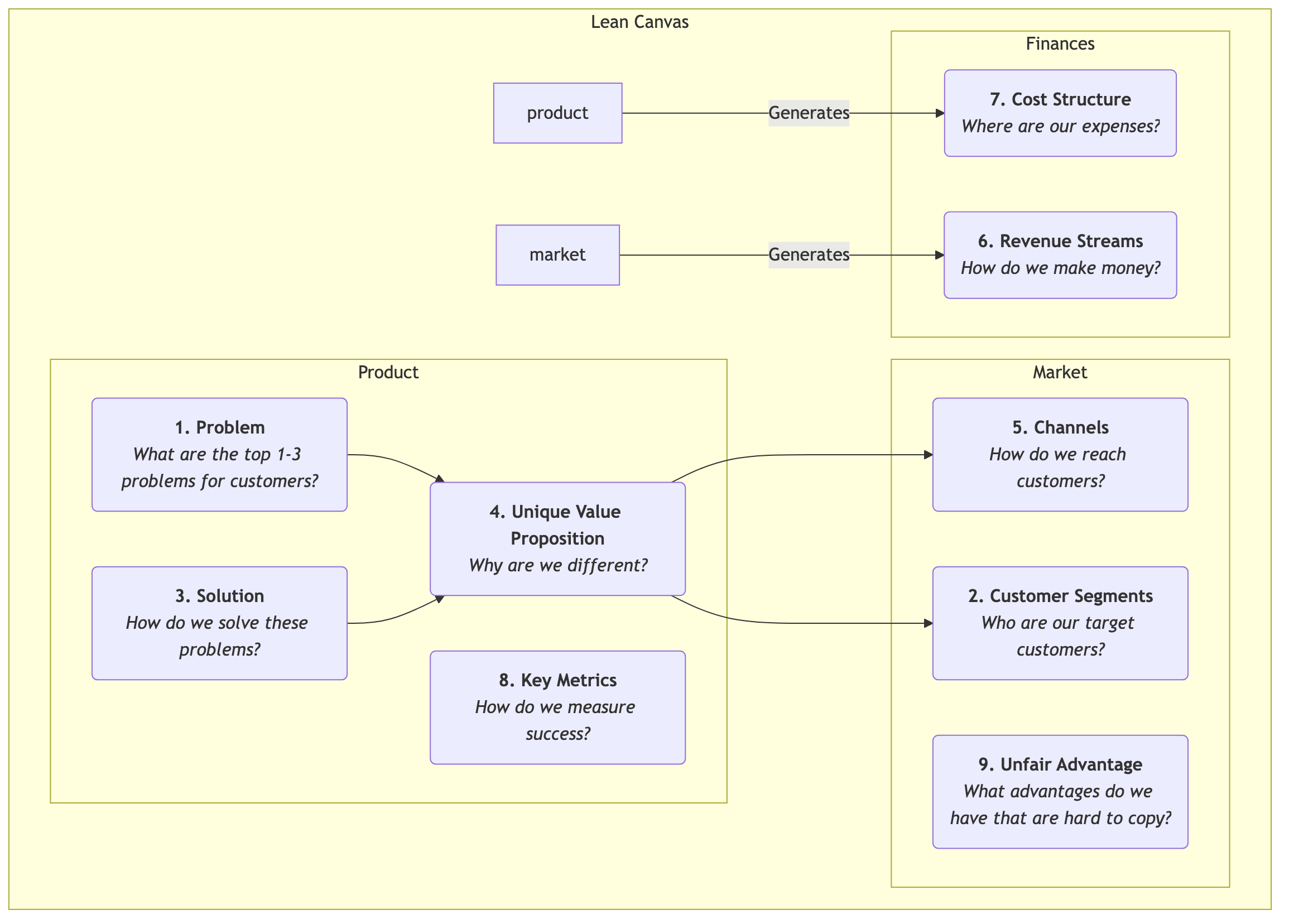
Differences from Business Model Canvas:
- Problem replaces "Key Partners": This is the most important change. It forces entrepreneurs to first clearly define the top 1-3 problems their target customers urgently need to solve.
- Solution replaces "Key Activities": After defining the problem, you then propose your solution (usually the core features of the product) specifically for it.
- Key Metrics replaces "Key Resources": For a startup, the most important thing is not what resources it possesses, but how to measure the health and growth of the business. Key metrics are the baton that drives all actions.
- Unfair Advantage replaces "Customer Relationships": This is also known as "unfair advantage" or "moat," referring to core competencies that cannot be easily copied or bought by competitors. This is crucial for the long-term survival of the business model.
How to Use Lean Canvas
The process of using Lean Canvas is a continuous cycle of validation and iteration.
-
Draw Your "Plan A" Canvas Before talking to any customers, quickly fill out a Lean Canvas with all your initial ideas and hypotheses for the startup project. This usually takes only 15-20 minutes. This is your "Plan A," a collection of all your hypotheses to be validated.
-
Identify the Highest-Risk Hypotheses Review your first version of the canvas and identify the parts with the highest risk and uncertainty. Typically, for a new project, the highest-risk hypotheses in order are:
- Problem-Customer Hypothesis: Does this problem truly exist? Are these people really your target customers?
- Problem-Solution Hypothesis: Can your solution truly solve their problem?
- Pricing-Value Proposition Hypothesis: Are customers willing to pay for your solution?
-
Systematically Validate Hypotheses Design and execute a series of "minimum viable experiments" (usually problem interviews and solution interviews) to systematically validate your high-risk hypotheses. For example:
- Conduct Problem Interviews: Go out and talk to your target customers, but don't talk about your product. Your sole purpose is to deeply understand their problems, existing behaviors, and pain points to validate the "Problem" and "Customer Segments" blocks on the canvas.
- Conduct Solution Interviews: After validating that the problem indeed exists, show your solution (which can be a prototype, a demo) to customers to validate your "Solution" and "Value Proposition," and test their willingness to pay ("Revenue Streams").
-
Iterate Your Canvas Continuously update and iterate your Lean Canvas based on the insights gained from interviews and experiments. Some hypotheses are validated, others are disproven. The canvas is like an experimental notebook, recording the complete evolutionary path of your startup project from its initial conception to finding "product-market fit."
Application Cases
Case 1: Dropbox (Cloud Storage Service) Early Canvas
- Problem: Syncing files across multiple devices is cumbersome; sending large files via USB drives or email is painful; forgetting to back up leads to data loss.
- Customer Segments: Tech enthusiasts with multiple computers, freelancers.
- Unique Value Proposition: "Put your files in a 'magic pocket', accessible anywhere, never lost."
- Solution: A desktop application that runs seamlessly in the background, automatically syncing the contents of a designated folder.
- Key Metrics: Number of user registrations, file upload success rate, number of active users.
- Unfair Advantage: Network effect – the more people use it, the easier it is to share and collaborate.
- Validation: Founder Drew Houston created a simple product demo video and posted it in a tech enthusiast community. Overnight, the waiting list surged from 5,000 to 75,000 people, strongly validating the "problem-solution" fit.
Case 2: A Planned "Healthy Meal Delivery" Service
- Problem: Office workers find it hard to eat healthy, balanced lunches; preparing meals themselves is too time-consuming; takeout is generally greasy.
- Customer Segments: Health-conscious young professionals with fitness habits.
- Unique Value Proposition: "Nutritionist-designed, freshly prepared fitness meals, delivered on time to your office."
- Solution: Offer weekly lunch meal plans, with menus updated weekly, and calorie and nutritional information provided.
- Key Metrics: Weekly repurchase rate, customer lifetime value.
- Unfair Advantage: Exclusive partnerships with high-quality ingredient suppliers, professional nutritionist team.
- Validation: The founder could initially avoid developing an app and instead accept orders through a WeChat group or survey platform, manually delivering lunches to the first 20 users to validate the entire process and user needs.
Case 3: Airbnb's Early Canvas
- Problem: During popular conferences, city hotels are expensive and fully booked.
- Customer Segments: Designers attending design conferences with limited budgets.
- Solution: Provide a platform for local residents (hosts) to rent out their spare air mattresses to these designers.
- Unique Value Proposition: Get accommodation at a lower price and have the opportunity to interact with locals.
- Validation: The founders themselves put three air mattresses in their home and successfully rented them out to designers attending the conference, personally validating the feasibility of the entire business model.
Value and Limitations of Lean Canvas
Core Value
- Risk Focus: Forces entrepreneurs to confront the highest-risk hypotheses from the outset.
- Speed and Iteration: Very suitable for quickly sketching, discussing, and iterating business models, perfectly fitting the Lean Startup rhythm.
- Problem-Centric: Ensures that the starting point of the venture is to solve a real, valuable customer problem.
Potential Limitations
- Insufficient Attention to External Environment: Like the Business Model Canvas, it does not inherently include analysis of competition and the macro-environment.
- Not Applicable to All Businesses: It is most suitable for high-uncertainty startups. For mature companies with validated business models, the Business Model Canvas might be a more comprehensive tool.
Recommended Order for Filling In the Lean Canvas
| Order | Block | Tip |
|---|---|---|
| 1 | Customer Segments | Identify early adopters, the people who feel the problem most |
| 2 | Problem | List the top 1–3 problems and the existing alternatives people use today |
| 3 | Unique Value Proposition | One clear sentence: why you're different and worth attention |
| 4 | Solution | The simplest features that address each problem |
| 5 | Channels | Free and paid paths to reach early adopters |
| 6 | Revenue Streams | Pricing model; price is part of the product |
| 7 | Cost Structure | Costs to reach break-even, including customer acquisition |
| 8 | Key Metrics | The few numbers that show progress (often activation and retention) |
| 9 | Unfair Advantage | Something that can't easily be copied or bought; leave blank if you don't have one yet |
Problem Interview Script (Short Version)
- Set the scene: "We're researching how people handle [problem area]. There's nothing to sell."
- Collect background: "Tell me about your role and how [area] fits into your week."
- Rank problems: "Here are three problems others mention. How would you rank them for you?"
- Explore the top problem: "Tell me about the last time this happened. What did you do? What did it cost you?"
- Existing alternatives: "How do you deal with it today? What do you like and dislike about that?"
- Wrap up: "Can we follow up when we have something to show? Who else should we talk to?"
Common Mistakes
- Starting with the solution. Filling in the Solution box first leads you to look for customers who fit your idea. Start with customers and problems.
- Vague customer segments. "Small businesses" is too broad; "independent cafés with 2–10 staff" can be found and interviewed.
- Vanity metrics. Downloads or page views rarely indicate progress. Choose metrics tied to value delivered, such as weekly active use or retention.
- Faking an unfair advantage. "Great team" or "first mover" is rarely unfair. It's fine to leave the box empty early on.
- Never updating it. A canvas written once and never revised has stopped being a learning tool.
Frequently Asked Questions
What is the difference between the Lean Canvas and the Business Model Canvas?
The Lean Canvas replaces Key Partners, Key Activities, Key Resources and Customer Relationships with Problem, Solution, Key Metrics and Unfair Advantage, shifting the focus from describing a business to testing the riskiest assumptions of a startup.
How long should it take to fill in a Lean Canvas?
About 15–20 minutes for a first version. Speed is the point: capture your current assumptions, then spend your time testing them.
What is an unfair advantage?
Something that can't easily be copied or bought: insider information, a network effect, a community, exclusive access, or a dream team with rare expertise. Most early startups don't have one yet.
Can existing companies use the Lean Canvas?
Yes, for new products or ventures inside a company where uncertainty is high. For mature, validated businesses, the Business Model Canvas is usually more appropriate.
Extensions and Connections
- Business Model Canvas: Lean Canvas is an important variation and development of the Business Model Canvas in the context of Lean Startup.
- Customer Development: A methodology proposed by Steve Blank, emphasizing "getting out of the building" to validate hypotheses, which serves as a guiding principle for Lean Canvas at the action level.
- Value Proposition Canvas: Can serve as a deepening tool for the "Problem," "Solution," and "Unique Value Proposition" blocks in Lean Canvas, helping entrepreneurs refine the product-market fit more precisely.
Reference: Ash Maurya's "Running Lean" is the most authoritative source for Lean Canvas, detailing how to use and iterate the Lean Canvas step-by-step in conjunction with customer development. This method is deeply influenced by Eric Ries's "The Lean Startup" and Steve Blank's Customer Development model.