Introduction to ESG Reporting
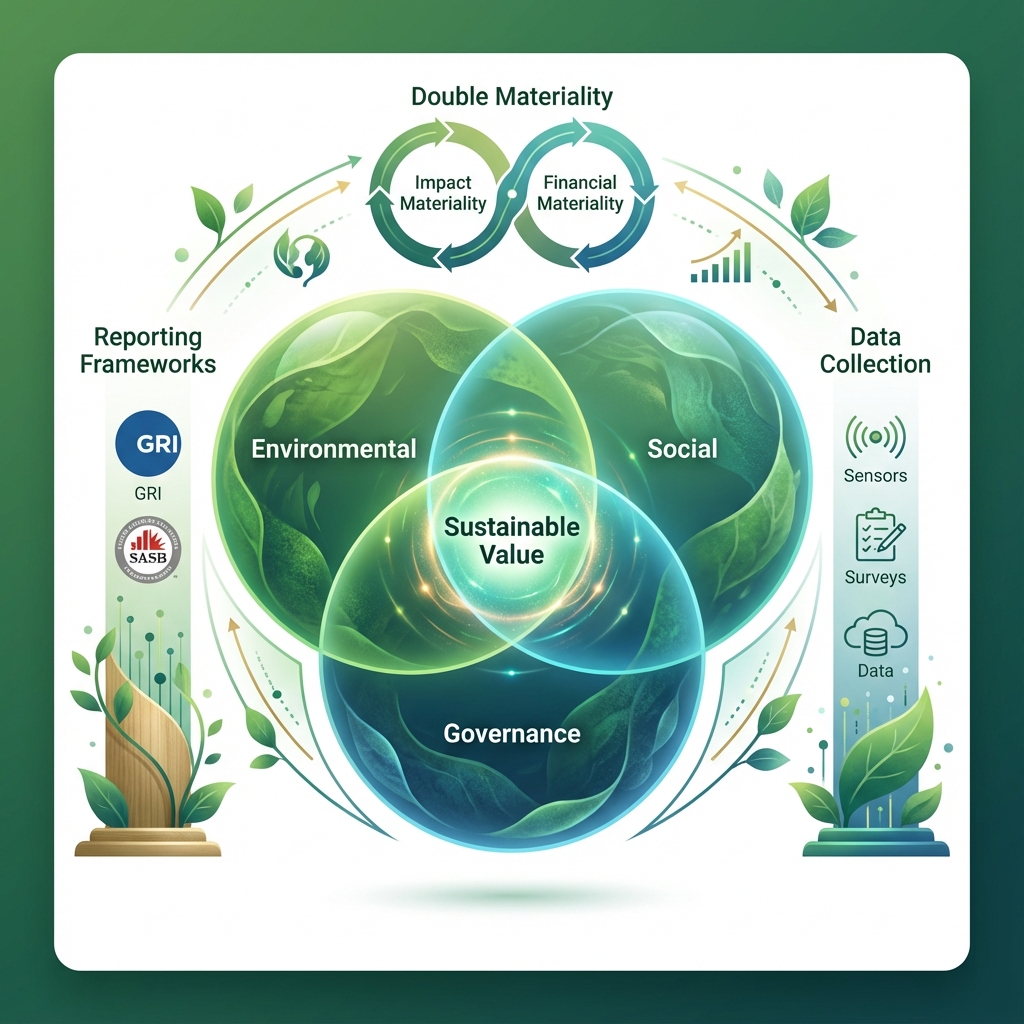
Investors, lenders, customers, employees and regulators increasingly want to know more than a company's profits. How exposed is it to climate risk? How does it treat its workforce and supply chain? Is it governed responsibly? ESG reporting is the practice of measuring and disclosing a company's performance and risks across Environmental, Social and Governance topics in a structured, comparable way.
Good ESG reporting is not a marketing brochure. It rests on a materiality assessment that identifies what matters, reliable data, and disclosure aligned with recognized frameworks, increasingly with external assurance. Requirements differ by country and have been changing quickly, so companies should check which rules apply to them in each jurisdiction.
Key takeaways
- E, S and G cover environmental impact, social relationships and governance quality.
- Materiality decides what to report: financial materiality (how sustainability issues affect the company) and impact materiality (how the company affects people and the planet). Together they form double materiality.
- Main frameworks and standards: GRI (impacts), ISSB IFRS S1/S2 (investor-focused, building on SASB and TCFD), ESRS under the EU's CSRD.
- Greenhouse gas emissions are reported by scope: Scope 1 (direct), Scope 2 (purchased energy), Scope 3 (value chain).
- Credibility comes from data quality, consistency and assurance, not from glossy narratives.
What ESG Covers
| Pillar | Example topics |
|---|---|
| Environmental | Greenhouse gas emissions, energy use, water, waste, biodiversity, pollution, climate risk |
| Social | Health and safety, labor practices, diversity and inclusion, human rights in the supply chain, community impact, data privacy |
| Governance | Board composition and independence, executive pay, business ethics, anti-corruption, risk management, shareholder rights |
Single vs. Double Materiality
| Perspective | Question | Main audience |
|---|---|---|
| Financial materiality ("outside-in") | How do sustainability issues affect the company's value, cash flows and risks? | Investors and lenders |
| Impact materiality ("inside-out") | How does the company affect people and the environment? | Broad stakeholders |
| Double materiality | Both of the above | Required under the EU's CSRD/ESRS |
Main Frameworks and Standards
| Framework / standard | Focus | Notes |
|---|---|---|
| GRI Standards | Impacts on economy, environment and people | The most widely used standards for sustainability reporting globally |
| ISSB (IFRS S1 and S2) | Sustainability-related financial information for investors | Issued in 2023 by the IFRS Foundation; IFRS S2 covers climate |
| SASB Standards | Industry-specific, financially material topics | Now maintained by the ISSB and used alongside IFRS S1 |
| TCFD recommendations | Climate-related financial disclosure: governance, strategy, risk management, metrics and targets | Incorporated into IFRS S2; the task force concluded its work in 2023 |
| ESRS (EU) | Detailed disclosure under the Corporate Sustainability Reporting Directive | Based on double materiality; scope and timelines have been revised by EU simplification measures |
| GHG Protocol | How to measure greenhouse gas emissions | The basis for Scope 1, 2 and 3 accounting in most frameworks |
Greenhouse Gas Scopes
| Scope | What it includes | Examples |
|---|---|---|
| Scope 1 | Direct emissions from sources the company owns or controls | Fuel burned in company vehicles and boilers |
| Scope 2 | Indirect emissions from purchased electricity, heat or steam | Electricity for offices and factories |
| Scope 3 | All other indirect emissions in the value chain (15 categories) | Purchased goods, business travel, use of sold products |
For many companies, Scope 3 is by far the largest share, and the hardest to measure.
How to Get Started
- Identify applicable requirements: regulations, stock exchange rules, customer and investor requests in your markets.
- Conduct a materiality assessment: engage stakeholders and analyze which topics matter most, financially and in terms of impact.
- Choose frameworks: often GRI for impacts plus ISSB/SASB for investors, or ESRS where required.
- Set up data collection: owners, definitions, systems and controls for each metric, starting with emissions, energy, workforce and governance data.
- Set targets and governance: board oversight, management responsibility, and targets linked to strategy.
- Report and seek assurance: publish consistently, explain methodologies, and obtain limited or reasonable assurance as required or as credibility demands.
- Improve each cycle: close data gaps, especially Scope 3, and integrate ESG into business decisions, not just the report.
Common Pitfalls
- Greenwashing. Vague claims ("eco-friendly", "carbon neutral") without evidence create legal and reputational risk.
- Reporting everything. Without materiality, reports become long and unfocused; disclose what matters.
- Spreadsheet chaos. ESG data needs the same controls as financial data if it is to be assured.
- Ignoring Scope 3. It is difficult, but often where most emissions and risks lie.
- Treating ESG as a reporting exercise only. The value comes from managing the risks and opportunities the data reveals.
Frequently Asked Questions
What is the difference between ESG and CSR?
CSR (corporate social responsibility) traditionally describes a company's voluntary social and environmental initiatives. ESG focuses on measurable performance and risks, often for investors, and is increasingly governed by standards and regulation.
What is double materiality?
Assessing sustainability topics from two perspectives: how they affect the company financially, and how the company affects people and the environment. A topic is material if it matters from either perspective.
Which ESG framework should a company use?
It depends on legal requirements and audiences. Companies subject to the EU's CSRD use ESRS; many others use GRI for impact reporting and ISSB (with SASB industry metrics) for investor-focused disclosure.
Is ESG reporting mandatory?
In a growing number of jurisdictions, for certain companies, yes. Rules, thresholds and timelines vary and have been revised frequently, so check current requirements in each market where you operate or are listed.
Extensions and Connections
- Balanced Scorecard: Integrating ESG objectives alongside financial, customer, process and learning measures.
- KPI: Defining ESG metrics with clear formulas, owners and targets.
- PESTEL Analysis: Scanning environmental, social and legal trends that create ESG risks and opportunities.
- Value Chain Analysis: Locating where in the value chain environmental and social impacts arise, which is essential for Scope 3.
Reference: GRI Standards; IFRS Foundation, IFRS S1 and IFRS S2 (2023); Task Force on Climate-related Financial Disclosures, Final Recommendations (2017); GHG Protocol Corporate Standard. Regulatory details change frequently; always consult the latest official sources.